
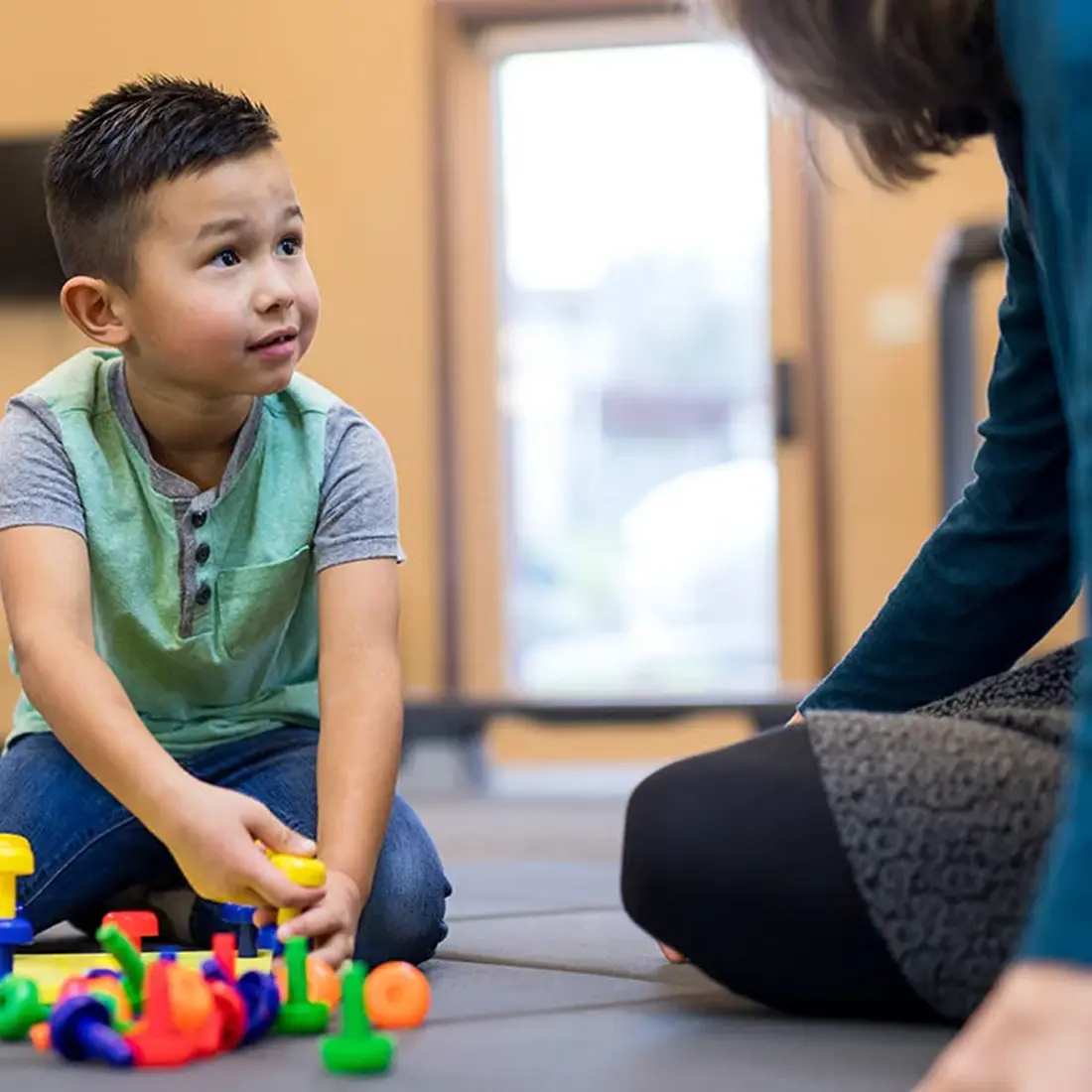
Play is how children process experience. It helps them rehearse situations, test outcomes, make sense of what has happened, and express what they cannot say. A trained therapist can follow what a child is working through in play and respond to it without ever requiring the child to explain themselves in adult terms.

Play Therapy in Brampton
Because a Seven-Year-Old Cannot Sit Down and Explain What Is Wrong
Ask a young child how they feel, and you will usually get "fine," or a shrug, or a change of subject to something about dinosaurs.
This is not avoidance. It is developmental. Children do not yet have the vocabulary for complex emotions, and more importantly, they often do not connect a feeling to its cause. What comes out instead is behaviour. Meltdowns, clinginess, stomach aches, trouble at school, a child who used to talk and now does not.
Play therapy works with the language children already have.
Start With a Conversation
Book a free 30-minute consultation: 416-409-8045.What Is Play Therapy?
Play therapy is a recognized therapeutic approach in which play is the medium of the work rather than a warm-up to it.
Play-based work does not depend on an elaborate playroom. Drawing, simple figures, games, stories, and building activities all give a child a way in. Your child's therapist will explain what sessions involve and whether there is anything your child might like to bring.
What happens is not random play. It is structured work that looks, deliberately, like play.
What It Actually Looks Like
A child who cannot say they feel left out may set up a game where one figure is repeatedly excluded.
A child frightened by conflict at home may draw the same house several weeks running, with something different about it each time.
A child processing a new baby, a bereavement, or a separation will usually play some version of it, often repeatedly, which is how children work things through.
The therapist notices patterns over time rather than interpreting single sessions. They are not decoding secret messages. They are paying close attention to what a child returns to.


What Can It Help With?
Depending on the child's circumstances and the therapist's clinical assessment, play therapy may support children experiencing:
- Anxiety, worry, and persistent overthinking
- Depression and low mood
- Chronic stress and burnout
- Avoidance that has narrowed daily life
- Harsh self-criticism
- Grief and loss
- Chronic pain and long-term health conditions
- Difficult experiences from the past that continue to intrude
- Feeling stuck or disconnected from what used to matter
- Living with a long-term condition or diagnosis
It is often useful for people who have already tried to think their way out of something and found that understanding it did not change it.
ACT is not automatically right for everyone, and a therapist should assess that rather than assume.
Where Parents Fit In
Parents are part of the process, not outside it.
The first appointment is usually with parents alone, to understand what has been happening at home and school before the child arrives.
After that, involvement varies. It may include regular parent sessions, conversations about progress, or work on how to respond differently to a recurring situation at home. A child spends an hour a week with a therapist and the rest of it with you, which is where most change actually happens.
Confidentiality for young children works differently from adults, and your therapist will clearly explain what they will and will not share before the work begins.
Children's Counselling →What Parents Usually Notice
It is not a child who suddenly discusses their feelings.
What tends to change first is recovery time. A difficult moment that used to take an hour takes twenty minutes. Mornings that were once a battle are now slightly easier. Sleep improves. The school reports fewer incidents.
Progress with children is rarely a straight line, and regression during stressful periods is normal rather than a sign the work has failed.
Is This Program Right for My Child?
It may suit your child if they:
- Are young enough that sitting and talking about feelings is not realistic
- Show distress through behaviour rather than words
- Have had a significant change or difficult experience
- Struggle to explain what is wrong, or say nothing is
- Have physical complaints with no medical cause, once checked by a doctor
For older children and teenagers, more conversation-based approaches usually fit better.
Counselling for Teens and Young Adults →Play-Based Therapy at C.S. Counselling
Two of our therapists use play-based methods in their work with children, alongside other approaches, according to their training and what your child needs.
Sierra Jones
Registered Psychotherapist (Qualifying)
Over five years working with children, adolescents, and families, including ADHD, autism, and neurodivergence.
Sabrina Abrol, RSW
Psychotherapist and Registered Social Worker
Sessions in English, Punjabi, Hindi, and Urdu can matter when a child or a grandparent involved in their care feels more at ease in another language.
Sessions with children usually take place in person at our Brampton clinic. Parent sessions can also be held online.
Meet Our Counselling Team →Frequently Asked Questions
Is my child just playing for an hour?
No. A trained therapist is working deliberately, using play as a method rather than a distraction.
Will I be told what happens in sessions?
Your therapist will explain at the start exactly how the process works for your child's age. Parents are kept informed about progress, and children are given enough privacy for sessions to be useful.
How old does my child need to be?
Play-based approaches suit younger children particularly. Tell us your child's age when you get in touch, and we will advise.
What if my child refuses to go?
Such behaviour is common and usually due to nervousness about the unknown. Sometimes a parent session first is the better starting point. Pressure tends to be counterproductive.
Does it work online?
It works less well for younger children, because play and activity are central. In-person sessions are usually the better arrangement at this age, though parent sessions work well online.
How long does it take?
It depends on the child and the situation and is reviewed as you go.
Start With a Conversation
You do not need to know what is wrong before getting in touch. Most parents do not.
Tell us what you have been noticing at home.
We'll start by listening.
Book Your Free 30-Minute ConsultationC.S. Counselling & Consulting Services
2250 Bovaird Drive E, Suite 408
Brampton, ON L6R 0W3
Play Therapy in Brampton | Children's Counselling in Peel Region
If you are worried about a child's immediate safety, please contact emergency services or a local crisis line. Ongoing counselling is not an emergency service.