


Cognitive Behavioural Therapy (CBT)
may help each of you notice the interpretations that fire during conflict and shape what you do next.

Most couples come in after a long run of small events rather than one dramatic one. The same disagreement about money, the in-laws, or who noticed what needed doing keeps coming up, but in different words each time. A conversation that begins reasonably and is unrecognizable four minutes later.
By the time people look for a couples therapist, they are usually more exhausted than angry. At C.S. Counselling & Consulting Services, relationship counselling starts by hearing both accounts, without deciding in advance who needs to change.
Couples counselling is a form of psychotherapy that helps partners understand recurring conflicts, improve communication, rebuild trust, and strengthen their emotional connection. Rather than deciding who is right or wrong, a couples therapist helps both partners recognize unhelpful relationship patterns and develop healthier ways of responding to each other. At C.S. Counselling & Consulting Services in Brampton, our approach considers each couple's experiences, emotional needs, relationship history, and goals.
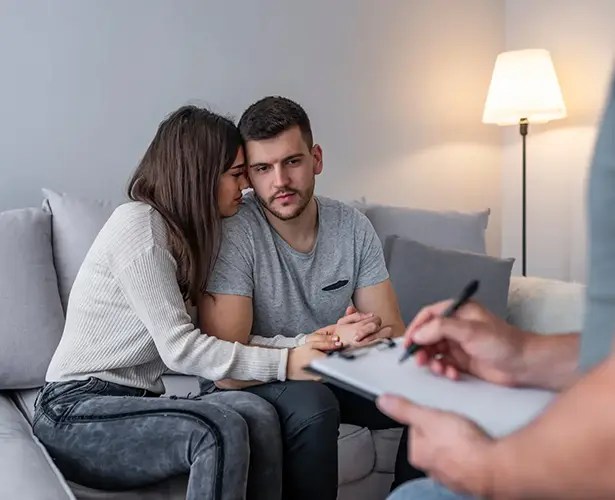
A couples counsellor is not a referee. The therapist helps both partners understand what happens during difficult conversations and why the same disagreements keep returning. For example, one partner may seek reassurance through repeated conversations while the other withdraws because they feel overwhelmed. Counselling helps identify the emotions behind these reactions and provides a supportive space to practise communicating differently, without turning sessions into another argument.
Couples counselling provides a structured, supportive environment where both partners can share their perspectives and explore concerns involving communication, emotional distance, trust, intimacy, parenting, or family expectations. At C.S. Counselling, therapists consider the relationship as a whole, including the influence of culture, life transitions, and individual experiences. Sessions focus on helping couples better understand each other and identify realistic changes that support their relationship goals.
You do not need a crisis to justify sitting down with a relationship therapist. Many couples wait years longer than they needed to. Does any of this information describe the last few months between you?
Distance rarely announces itself. Many couples describe getting in touch after noticing they had become polite with each other.
Our therapists work with a wide range of relationship concerns:

Your free consultation. A brief, free conversation about what brought you in and how long it has been going on. You will not be asked to agree on the story.
Being matched with a therapist you can both work with. Fit has to work for both partners, not only the one who booked. If it is not right for either of you, tell us.
Your first session together. Both of you get room to speak, and each of you says what you hope will be different. Part of a couple's therapist's job is making sure the hour does not become the argument you already have at home, with a witness
From there, sessions may explore:
Change here is usually undramatic. What often shifts first is recovery time: an argument that took three days now takes an hour.
may help each of you notice the interpretations that fire during conflict and shape what you do next.
looks at the times things go better than usual and what was different about them.
support noticing your reaction rising before it takes over the conversation.
Your therapist will discuss what may suit your situation within their training and scope.
No two relationships go wrong in the same way, so we do not start from a fixed plan.
Both partners describe what has been happening in their words.
We look at the relationship in context: history, culture, family expectation, workload, and what each of you learned about conflict long before you met.
We work toward evidence-informed strategies that fit the two people in the room.

Yes, and it does not have to be an attempt to save the relationship in order to be worth doing.
Counselling is often described as a last resort before separation, which puts a great deal of pressure on it. Some couples want repair. Others are genuinely unsure and want to understand what has happened before making a decision they cannot easily undo. Both are legitimate reasons for seeing a marriage counsellor.
What counselling may offer at this stage is a clearer view of what is driving the distance. Whether the difficulty is a pattern that can change or a difference in what each of you needs. Whether you still want the same relationship or have been holding different versions of it.
Sometimes that clarity leads to repair. Occasionally it leads to a decision to separate, reached with less blame than it would otherwise have carried. Nobody can promise which way it goes.
Yes. Individual counselling for a relationship concern is common, legitimate work, and it is often where couples' work begins.
When one person changes what they do in a recurring pattern, the pattern changes too, even if the other partner has agreed to nothing. That is not a way of fixing your partner. It is a way of seeing your part clearly enough to stop repeating it.
Individual sessions may help you work out what you want, look at what you contribute to the cycle, and speak differently about things left unsaid for years.
A partner who says no at first sometimes engages later, often once they see the work is not a case being built against them. Some never do, and that is information too.
Pressure rarely helps. If your partner is unwilling, starting on your own is a reasonable place to begin.
Our team includes psychotherapists and registered social workers who support couples with relationship concerns. Depending on what you need, you may work with a therapist experienced in conflict and communication, rebuilding trust, or relationships under the strain of major change.
You can find each professional's designation, training, languages, and areas of practice on their profile
Meet Our Counselling TeamC.S. Counselling & Consulting Services has supported individuals, couples, and families since 2011. Founded by Coslyn Selby, a Registered Social Worker and psychotherapist, our Brampton-based practice has supported more than 2,000 clients. Our multidisciplinary team includes regulated mental health professionals who provide personalized counselling and psychotherapy services across Ontario.
For many couples in Brampton, a relationship is not something they live privately. Extended family, community expectations, and different ideas of what a marriage should look like are often part of what you carry.
Partners also grew up with different rules about disagreement. In one family, raised voices meant little. In another, they meant something was wrong. Where it matters, there is space for it here.
Couples Counselling in Brampton and Online across Ontario
C.S. Counselling & Consulting Services 2250 Bovaird Drive E, Suite 408 Brampton, ON L6R 0W3We support couples from Brampton, Mississauga, Caledon, and the wider Peel Region, along with the Halton Region, Toronto, and surrounding communities.
Virtual relationship counselling may be available for suitable clients across Ontario, which helps when shift work or childcare makes a shared appointment difficult.
Many couples find that counselling helps them understand their patterns and argue with less damage. Results vary, and a therapist can discuss what may be realistic for your situation.
Relationship counselling can help with conflict, distance, trust, and decision-making. It tends to work best when both people look at their part, though useful work can begin with one partner.
There is no fixed cut-off point. Couples come in at very different stages, including some already unsure whether they will stay together.
Yes. Counselling is available to partners at any stage, including dating, common-law, engaged, and separated couples.
Counselling can offer a structured place to talk about what happened and what each person needs now. Some couples rebuild, and some decide not to continue, and no therapist can promise which it will be.
You can attend on your own and work on the relationship concern individually. Some partners join later, and pressure rarely improves things.
There is no set number of sessions or months. The more useful question is whether anything has begun to shift, which you can review openly with your therapist.
Yes, this issue is a common reason couples seek support. The work focuses on understanding the relationship clearly enough to make a considered decision, rather than steering you anywhere.
Booking is often the hardest part, because it makes the difficulty official. You do not need agreed terms or a tidy explanation first.
Tell us what has been happening between you. That is the whole first step
Couples Counselling & Marriage Therapy in Brampton Virtual Relationship Counselling Across Ontario
If you are in immediate distress or worried about your safety, please contact emergency services or a local crisis line. Ongoing counselling is not an emergency service.