
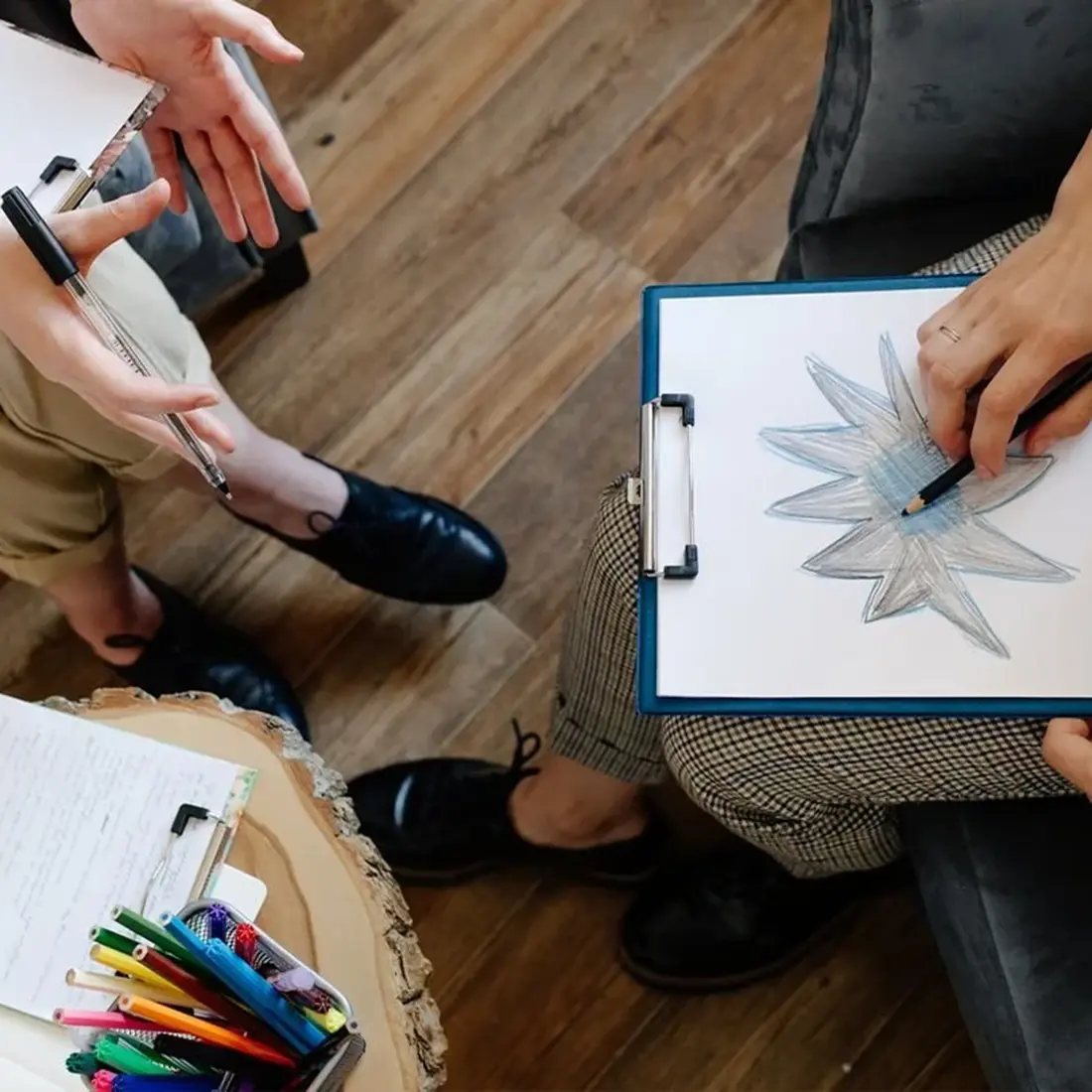
It is not an art class. Nobody assesses whether the result is any good, and artistic ability is completely irrelevant. People who insist they cannot draw are not at a disadvantage.

Art Therapy in Brampton
When There Are No Words, or the Words Have Stopped Helping
Some things cannot be expressed in sentences.
People who have talked about an experience many times can find that their account has become smooth and lost its meaning. Children often cannot express a feeling in words. And some experiences were never stored in language to begin with, which is why describing them can feel like translating something that has no equivalent.
Art therapy offers a different route to the same material.
Start With a Conversation
Book a free 30-minute consultation: 416-409-8045.What Is Art Therapy?
Art therapy is a recognized therapeutic approach in which making something visual is part of the work rather than a hobby attached to it.
The making does two things, though. It provides a way to express something without having to find the words for it first. And it puts the difficulty outside you, on paper, where you can look at it from a distance rather than only experience it from inside.
The therapist does not interpret your work back at you like a test. The conversation is usually about what the process was like and what you notice, with you as the authority on your material.
Why It Reaches Things Talking Sometimes Cannot
Language is a relatively recent and quite specific tool. A great deal of emotional experience is stored as image, sensation, and feeling rather than narrative.
There is also the practical matter of rehearsal. Anything you have described repeatedly develops a fixed version. The words come out in the same order and stop producing any effect. Making something visual bypasses the rehearsed account and often surfaces what the retelling had smoothed over.
For children the reasoning is simpler. Drawing is already one of their main ways of expressing experience, so it requires no adaptation at all.

What Can It Help With?
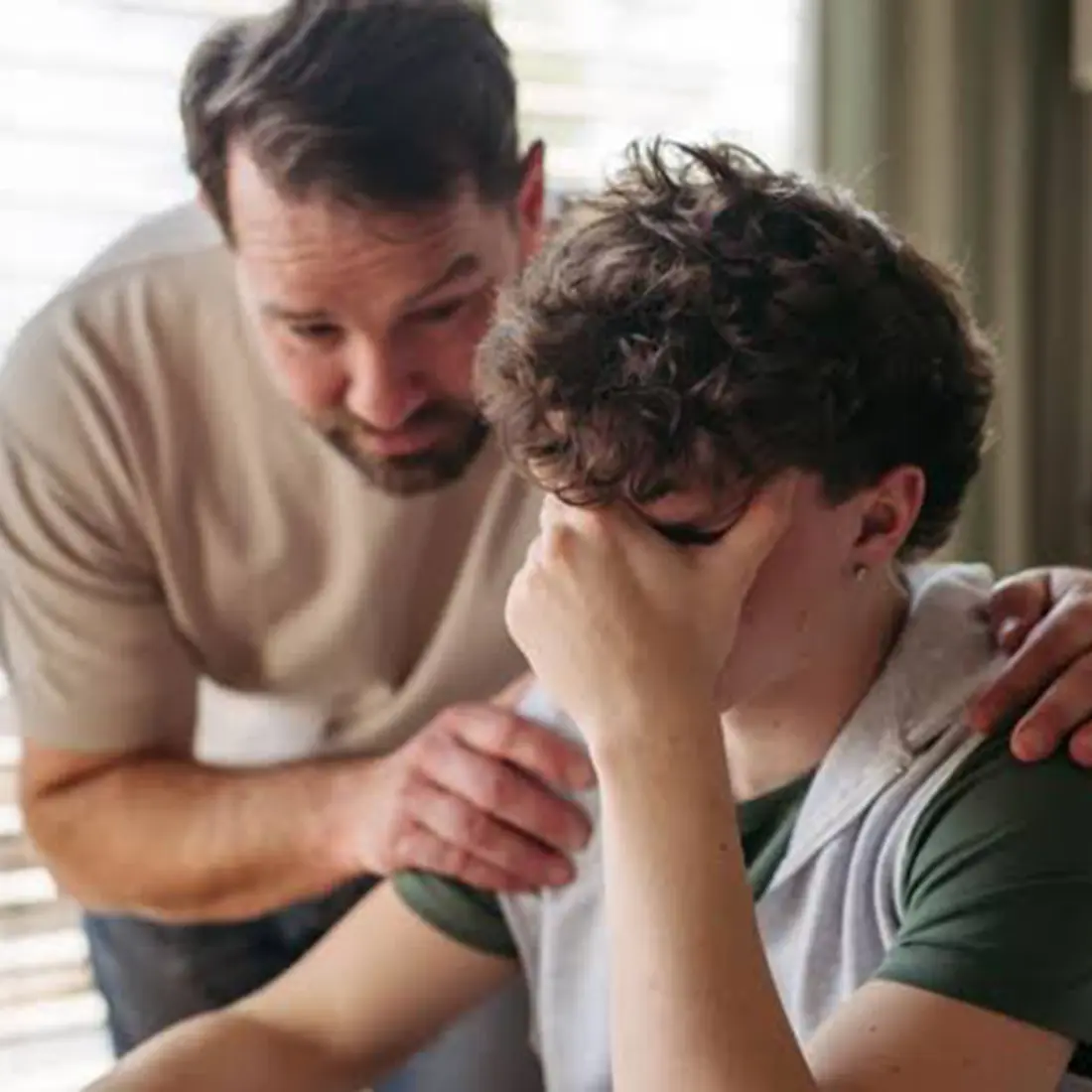
Depending on your circumstances and the therapist's clinical assessment, art-based approaches may support people experiencing:
- Anxiety, worry, and persistent overthinking
- Depression and low mood
- Chronic stress and burnout
- Avoidance that has narrowed daily life
- Harsh self-criticism
- Grief and loss
- Chronic pain and long-term health conditions
- Difficult experiences from the past that continue to intrude
- Feeling stuck or disconnected from what used to matter
- Living with a long-term condition or diagnosis
It is often useful for people who have already tried to think their way out of something and found that understanding it did not change it.
ACT is not automatically right for everyone, and a therapist should assess that rather than assume.
What Might a Session Involve?
You might be invited to work with a particular material, or to respond to a theme, or simply to begin and see what emerges.
Materials matter more than people expect. A pencil allows control and precision. Paint is harder to control, which is sometimes the point. Clay involves the hands and the body. A therapist chooses with intent.
Talking usually happens alongside or afterwards, and the conversation tends to be about the experience of making rather than a judgement of the result. What did you notice? What was difficult? What did you want to change and decide not to?
Sessions are confidential, and so is what you make.
Is This Approach Right for Me?
It may suit you if you:
- Find it difficult to put feelings into words
- Have talked about something so often it has lost its meaning
- Find sustained eye contact and direct emotional conversation uncomfortable
- Are seeking support for a child who cannot yet explain themselves
- Process things visually rather than verbally
- Have found talking-based therapy helpful but incomplete
It may suit you less if you want a structured, goal-focused approach with measurable steps, or if the idea of making something feels more exposing than talking. Both are reasonable.
You do not need any artistic ability. That is worth repeating, because it is the reason most people rule this out.
Art Therapy at C.S. Counselling
[CLIENT TO ADD WHEN AVAILABLE: name, designation and art therapy qualification of the therapist providing it, the age groups they work with, and whether sessions are in person, online or both.]
If you are drawn to creative ways of working, it is also worth knowing that Komal Pithava, Registered Psychotherapist (Qualifying), uses expressive arts-based techniques within her counselling where appropriate. This is not the same as formal art therapy, but it can offer a route to material that is hard to reach through conversation alone.
Frequently Asked Questions
I cannot draw. Can I still do this?
Yes. Artistic skill is irrelevant, and nothing is assessed. People who are convinced they have no ability often engage with it most freely.
Will the therapist analyze my drawings?
Not in the sense people imagine. There is no code being decoded. You are treated as the authority on your own work.
Is it only for children?
No. It is used with children, young people, and adults.
Do I have to show anyone what I make?
What you make is confidential, and you decide what you say about it.
Is it a real therapy or a craft activity?
It is a recognized therapeutic approach delivered by trained practitioners. It is not an art class.
Does it work online?
Some art-based work can be adapted, though materials and the shared space matter. Your therapist will give you an honest view.
Start With a Conversation
You do not need to know which approach suits you before getting in touch.
Tell us what has been happening, including if you have found it difficult to express.
We'll start by listening.
Book Your Free 30-Minute ConsultationC.S. Counselling & Consulting Services
2250 Bovaird Drive E, Suite 408
Brampton, ON L6R 0W3
Art Therapy in Brampton | Virtual Counselling Across Ontario
If you are in immediate distress or concerned about your safety, please contact emergency services or a local crisis line. Ongoing counselling is not an emergency service.